Social Engineering in Cyber Security: How Attackers Manipulate People in 2026
Admin · Jul 17, 2026
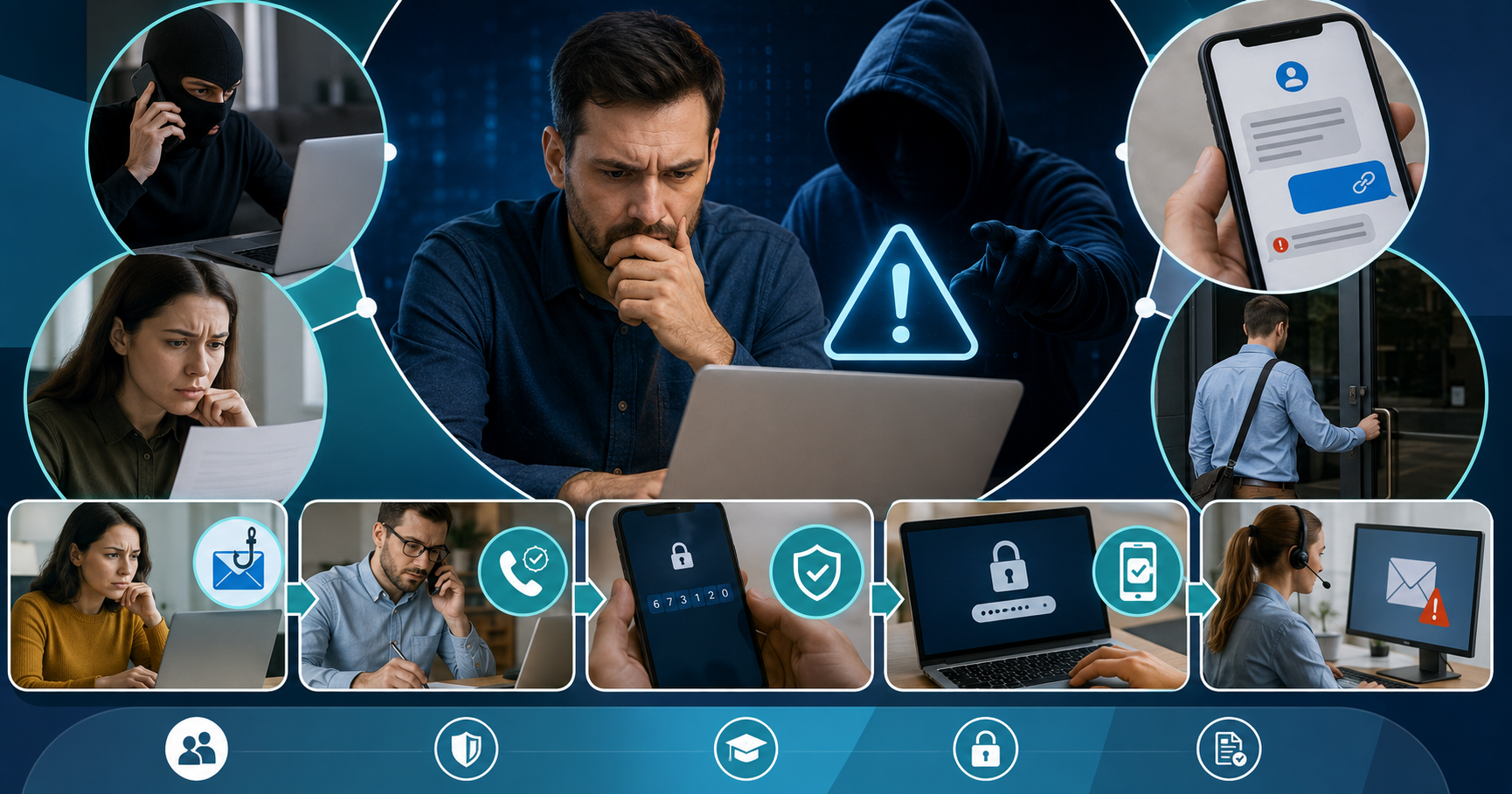
Most cyberattacks in 2026 don't start with a broken firewall. They start with a phone call, a text message, or an email that feels just real enough to trust. That's social engineering, and it remains one of the biggest blind spots in cyber security today, because it targets human judgment instead of code.
This guide breaks down what social engineering is, how it fits into the bigger picture of cyber security, and what practical steps individuals and businesses can take to defend against it in 2026.
What Is Social Engineering in Cyber Security?
Social engineering is the practice of tricking a person into giving up information, access, or money by exploiting trust, urgency, or fear rather than exploiting software. Instead of breaking into a system, an attacker convinces someone inside the system to open the door for them.
Unlike a virus or an exploit, social engineering doesn't need a technical flaw to succeed. It only needs a distracted employee, a convincing story, and enough pressure to skip a second thought.
Main Purpose Behind Social Engineering Attacks
The purpose is almost always the same: get access. That could mean login credentials, payment details, remote access to a device, or confidential company data. Once an attacker has that access, the rest of the attack — data theft, ransomware, fraud — becomes much easier.
Common Types of Social Engineering Attacks
Phishing – fake emails or messages designed to steal credentials or install malware.
Vishing – phone calls impersonating banks, tech support, or company executives.
Smishing – phishing attempts sent through SMS text messages.
Pretexting – inventing a believable scenario to request sensitive information.
Baiting – offering something enticing, like a free download, to trigger a malicious action.
Tailgating – physically following an authorized person into a restricted area.
Why Social Engineering Works So Well
Attackers rely on predictable human reactions: urgency, authority, fear of getting in trouble, and the desire to be helpful. A message that says "your account will be locked in ten minutes" is designed to make someone act before they think. That single design choice is what makes social engineering more effective than many technical exploits.
Real-World Impact of Social Engineering
Business email compromise scams, where an attacker impersonates a CEO or vendor to authorize a fake wire transfer, have cost companies billions of dollars globally. Many major data breaches over the past decade trace back not to a hacked server, but to one employee who clicked the wrong link or trusted the wrong caller.
How to Prevent Social Engineering Attacks
Verify unexpected requests through a second channel, such as a phone call to a known number.
Never share passwords, one-time codes, or remote access tools based on an unsolicited request.
Slow down when a message pushes urgency, fear, or secrecy.
Use multi-factor authentication (MFA) so a stolen password alone isn't enough.
Report suspicious messages to your IT or security team immediately.
Security Awareness Training Matters More Than Ever
Technical tools like spam filters and endpoint security help, but the strongest defense against social engineering is a trained, alert workforce. Regular, realistic training — including simulated phishing tests — helps employees recognize red flags before they become victims.
Compliance and Social Engineering
Frameworks such as ISO 27001 and NIST increasingly require organizations to document social engineering awareness training as part of their broader risk management program, alongside encryption, access control, and incident response planning.
Who Should Care About Social Engineering
Every business, regardless of size, is a target. Small businesses are often targeted precisely because they have fewer security resources. Large enterprises are targeted because a single successful attack can unlock enormous amounts of data. Individuals are targeted for financial fraud and identity theft.
Tools That Help Reduce Social Engineering Risk
While no software can fully replace human judgment, tools that clean up metadata, verify files, and manage documents safely reduce the attack surface. For example, teams handling shared documents can rely on free online tools to check and sanitize files before sharing them externally, reducing the chance that a manipulated file slips through.
If you're managing PDFs shared over email — a common vehicle for baiting attacks — Toolsimpli's PDF Tools can help you inspect and convert files safely before opening anything unfamiliar.
Frequently Asked Questions
Is social engineering considered a cyberattack?
Yes. Even though it targets people instead of software, social engineering is classified as a cyberattack because its goal is unauthorized access to systems, accounts, or data.
Can antivirus software stop social engineering?
Antivirus tools can catch some malicious attachments or links, but they can't stop a person from voluntarily handing over a password. Awareness and verification habits are the real defense.
What is the most common social engineering technique in 2026?
Phishing, especially AI-generated phishing emails that mimic writing style and branding convincingly, remains the most common technique, followed closely by vishing scams using voice-cloning technology.
Final Point
Social engineering isn't going away in 2026 — if anything, AI tools are making these attacks more convincing. The best defense combines healthy skepticism, verification habits, and ongoing training, backed by basic technical safeguards like MFA. For more practical guides like this one, check out our Read Latest Blogs section, and if you have questions about how our tools support safer file handling, visit our FAQs page.